
08.25.2026


Manufacturing plants are one of the most complex environments when it comes to safety and security.
Not only are these facilities full of potential hazards to human safety, but they also house expensive equipment and manufactured products that make them high-risk targets for forced entry and theft.
To ensure the protection of assets, manufacturing facility owners and managers should take a multi-layered approach that includes robust physical security measures. This approach should be tailored to the facility itself, ensuring the physical layers actually keep would-be intruders out of secured areas.
This guide covers how to protect manufacturing facilities with commercial-grade security shutters, high-security doors, and security screens designed to secure production areas, loading docks, warehouses, equipment, and valuable inventory.
The Importance of Manufacturing Plant Security
Manufacturing facilities present an appealing target for criminals for a simple reason: they store large volumes of valuable goods, raw materials, and equipment, often in buildings that were not designed with security as a top priority, or that were designed long ago without modern security threats in mind.
Loading docks, ground-floor windows, and rear exit doors are common points of entry for thieves looking to access a facility after hours, when the building is unoccupied and response time to an intrusion is slowest.
Forced entry through an unprotected door or window is one of the most common tactics used in manufacturing facility break-ins. Intruders may pry open an emergency exit door, break a window, or exploit another weak point in the building envelope to gain access, then make off with equipment, tools, raw materials, or finished products before anyone notices.
Beyond the direct cost of stolen goods, a breach in manufacturing plant security can also mean damaged property, halted production, and disrupted supply chains while the facility recovers.
Because every manufacturing plant has a different layout, different points of vulnerability, and different assets to protect, the first step toward better security should be a professional threat assessment.
A qualified security consultant can walk the property, identify weak points such as unsecured windows, exposed loading docks, or older doors that are easy to force open, and recommend a layered plan built around the facility's actual risk profile rather than offering up a generic checklist.
How To Improve Manufacturing Plant Security
Once a facility's vulnerabilities have been identified, owners and managers can begin closing the gaps by implementing physical manufacturing plant security measures designed to resist forced entry. Three of the most effective options for these types of environments are:
- Roll-down security shutters
- High-security exit doors
- Security screens
1. Roll-down security shutters
Roll-down security shutters cover doors and windows when a facility is closed, locking into place to create a solid physical barrier between the outside and the building's interior.
Ground-floor windows and glass entryway doors are especially vulnerable after hours since they are easy to break through and offer a fast way in. A roll-down shutter eliminates that vulnerability by covering the glass entirely, so there is no exposed pane for an intruder to shatter.
Because the shutters lock into place, they also resist prying and lifting, giving facilities a dependable layer of after-hours protection at entry points that would otherwise be left unguarded overnight.
Recommended manufacturing plant security shutters: AL8 Commercial rolling shutters.
2. High-security exit doors
Emergency exits and loading dock doors are frequently overlooked in facility security planning, largely because they are used for secondary functions rather than as a primary entrance. That oversight makes them an attractive target.
These doors are vulnerable to a range of forced entry tactics, including cutting, drilling, prying, and ramming, particularly if they are older or built to standard commercial specifications rather than security-rated ones.
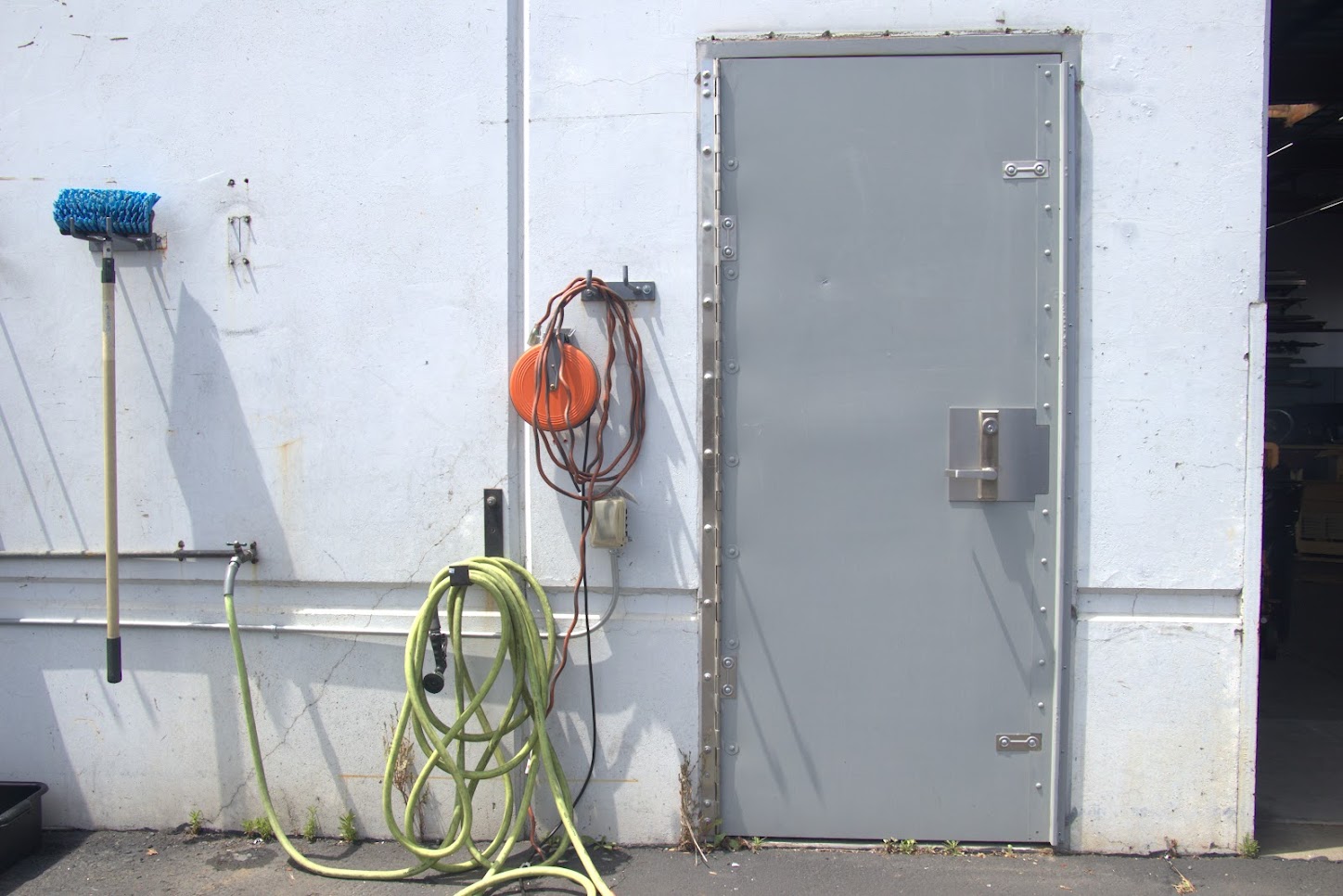
A high-security exit door is built to withstand these methods, with reinforced frames, hardened locking hardware, and door construction designed to resist cutting and prying tools. Securing these often-overlooked openings closes a gap that many facilities do not think to address until after an incident occurs.
Recommended high-security exit doors for manufacturing facilities: HD1 commercial high-security exit doors.
3. Security screens
Many manufacturing plants rely on operational windows for ventilation, especially in areas where equipment generates heat or where fumes need to be managed. The problem is that these windows are sometimes left open by accident, whether at the end of a shift or overnight, leaving the facility exposed to forced entry through an opening created by human error.
Commercial security screens made from stainless steel mesh solve this problem by covering the opening with a barrier that resists cutting and forced entry, while still allowing air to pass through. This lets facilities keep windows open for ventilation without sacrificing security at those openings.
Recommended stainless steel security screens for manufacturing plants: fixed window security screens.
Other Manufacturing Plant Security Tips
Physical barriers like shutters, doors, and screens work best as part of a broader commercial security strategy. Other measures worth incorporating or updating with modern technology and best practices include:
- 24/7 monitored security cameras positioned at entry points, loading docks, and high-value storage areas
- Monitored alarm systems that alert security personnel or law enforcement the moment a breach is detected
- Access control systems that restrict entry to sensitive areas, helping mitigate internal theft as well as outside intrusion
- On-site security personnel, including after-hours patrols for larger facilities or those in higher-risk areas
- Regular maintenance checks on doors, windows, and locking hardware to catch wear or damage before it becomes a vulnerability
- Adequate exterior lighting around entry points, loading docks, and parking areas to deter nighttime intrusion attempts
Key Takeaways
Manufacturing facilities face real risks from forced entry and theft, but those risks can be significantly reduced with the right multi-layered security approach.
Physical manufacturing plant security measures like roll-down security shutters, high-security exit doors, and stainless steel security screens address the specific points of vulnerability that criminals look to exploit, from vulnerable glass entryways to overlooked back doors to ventilation windows left open by accident.
Paired with active monitoring, access control, and on-site security, these measures work together to both deter and actually keep intruders out, rather than simply alert a facility to a breach that has already happened.
Every manufacturing plant is different, and the right combination of security measures depends on the facility's layout, assets, and existing vulnerabilities. Contact QMi Security Innovations for a consultation to find the right combination of security solutions for your facility.
