
05.19.2026


Jewelry stores occupy a unique space in the retail world. Per square foot, few businesses hold more concentrated value in merchandise, meaning jewelers often face a much higher risk of theft than other retailers.
In recent years, organized retail crime groups have increasingly targeted jewelry retailers with highly coordinated smash-and-grab attacks and after-hours burglary using sophisticated forced entry techniques that can overwhelm conventional security measures in seconds.
According to the Jewelers’ Security Alliance (JSA), U.S. jewelry store losses total over $100 million a year, with a record 2,211 crimes committed against U.S. jewelry firms as recently as 2022.
For jewelry store owners and loss prevention specialists, taking a comprehensive, layered approach to jewelry store security has never been more important. From the storefront glass to backroom storage, every element of the physical environment needs to be reinforced to reduce risks.
Why Conventional Jewelry Store Security Measures Often Fall Short
The threat levels faced by jewelry retailers have spiked over the last few years, and the trend isn’t limited to one or two cities. From New York to Toronto to Los Angeles, the number of incidents, especially smash-and-grabs, has been shooting up.
Regardless of where such an incident unfolds, the security footage often looks the same: a group of masked robbers, who often appear to be young males, brazenly enters a jewelry store equipped with hammers and bags, quickly smashing glass displays, filling the bags with merchandise, and making a quick getaway before the police arrive. Even if some or all of the criminals are later caught, it never seems to be long before another virtually identical attack occurs.
Standard jewelry store security measures like cameras and alarms play an important role, but they are reactive solutions that do little to deter and nothing to prevent these types of smash-and-grabs.
For a jewelry store, where a single display case can hold tens of thousands of dollars in merchandise, reactive security is simply not enough. Preventing modern forms of retail theft demands proactive, physical security measures — barriers that prevent or significantly delay forced entry.
With the right multi-layered approach to jewelry store security, business owners and loss prevention teams can turn their store into a hard target.
4 Essential Layers of Jewelry Store Security
1. Always-There Storefront Glass Protection for Jewelry Retailers
The storefront is the most common point of attack in smash-and-grab incidents. Standard plate glass, and even tempered glass, offers minimal resistance to a determined assault. A single strike from a hammer or crowbar can shatter it instantly, leaving the entire sales floor exposed. This is why security glazing, such as Riot Glass, is one of the most effective tools in jewelry store security.
Riot Glass can be retrofitted into existing window and door frames, meaning you don't need to rebuild your storefront to achieve a dramatic improvement in forced-entry resistance.
Unlike standard glass, this high-performance security glazing is engineered to absorb and distribute impact force, holding together under repeated blows and dramatically extending the time required to breach it.
When a would-be intruder encounters glazing that doesn't shatter on the first blow, the attack takes longer, makes more noise, and dramatically increases their exposure. Most opportunistic and even organized attackers will abort rather than risk taking the additional time and getting arrested.
2. Roll-Down Security Shutters for After-Hours Burglary Protection
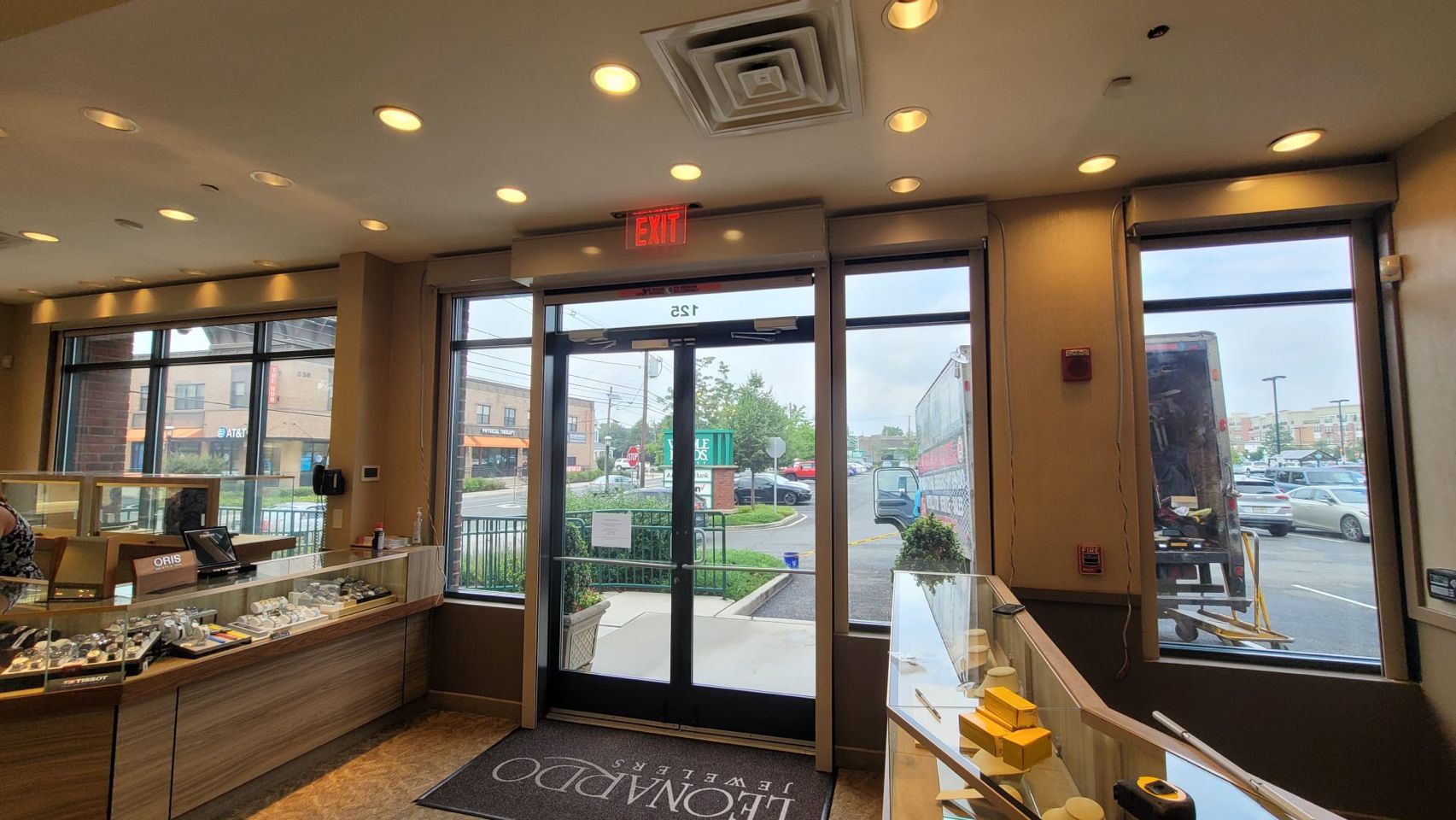
For after-hours forced entry protection, roll-down security shutters provide an additional hardened physical barrier that covers the entire storefront opening, providing even more protection against smash-and-grab or crash-and-grab (vehicular ramming) attacks and forced entry.
QMi's roll-down security shutters are engineered specifically for high-risk retail environments like jewelry stores and offer a balance between aesthetics and strength. When deployed, they effectively transform the storefront into a hardened perimete, one that signals to would-be attackers that this location will not yield quickly or quietly. When the shutters are rolled up into the minimalistic housing during business hours, the storefront is completely open, maintaining full visibility and natural lighting.
Beyond forced-entry resistance, security shutters also provide a secondary benefit: they conceal your merchandise and display cases from street view, removing the visual target entirely. For jewelry stores in high-foot-traffic areas or locations with significant after-hours vulnerability, this is a meaningful risk reduction in its own right.
3. High-Security Steel Exit Doors for Backroom and Emergency Exit Security
Back doors are a frequently overlooked vulnerability in retail security. Standard commercial inventory room or emergency exit doors, even those with good locks, can often be rammed in, pried open, or defeated through the door frame itself rather than the lock. For a jewelry store, every secondary door must be treated as a potential entry point for criminals.
High-security steel exit doors from QMi are purpose-built to close this gap in jewelry store security. Constructed with reinforced steel frames and heavy-duty hardware, these doors are designed to withstand the kind of forced-entry attempts that defeat standard commercial exit doors, including both physical battering and more sophisticated prying, cutting, and drilling techniques. They are engineered not just for strength, but for the specific threats facing high-risk retailers.
4. Locking Security Cases for Merchandise Storage
Even with a hardened perimeter, a determined intruder who does breach your storefront should face another barrier before reaching your most valuable inventory. Locking security cases (heavy-duty metal cases that fully enclose merchandise when not on display) provide that final line of defense.
QMi's locking security cases are not standard display cases with glass tops. They are fully enclosed metal cases designed for high-security merchandise storage. When locked, they protect inventory against smash-and-grab attempts at the case level, meaning even if an attacker reaches your sales floor or a back room, they face another hardened barrier that prevents access to your most valuable goods.
This layer is particularly valuable for overnight storage. Rather than relying solely on a vault or safe room, security enclosures allow high-value items to be secured throughout the store in a distributed fashion, reducing the concentration of risk in any single location.
Hardening Jewelry Store Security Layers From the Outside In
What distinguishes a truly effective jewelry store security strategy is not any single product, but rather the coherence of the overall system.
Each layer described above is more effective in combination than in isolation. Security glazing slows a frontal assault at any time of day. Roll-down shutters harden the storefront after hours. High-security exit doors reduce secondary door vulnerabilities. Robust security cases protect inventory behind an additional barrier.
The best time to evaluate your jewelry store's security posture is before an incident occurs. QMi Security Innovations works with jewelry retailers and loss prevention teams to assess existing vulnerabilities and design physical security solutions tailored to each location's specific threat profile.
Whether you're looking to harden a single location or standardize security across a chain of stores, QMi's portfolio of products, including Riot Glass security glazing, roll-down security shutters, high-security steel exit doors, and locking security cases, provides the building blocks for a comprehensive, multi-layered defense that secures your store from the outside-in.
Contact QMi Security Innovations today to schedule a consultation and learn how a layered physical security approach can protect your inventory, your staff, and your business.
